

What eight years of AWS re:Invent taught me about building cloud partnerships
By: Jessica Alexander, Founder & CEO
The power of just showing up
Back in 2017, CrowdStrike was becoming a very good AWS customer. Our spending on AWS was growing quickly, and as a security company, we aligned well with AWS’s shared responsibility model, with customers being responsible for security “in the cloud.” But we hadn’t leaned into what a true partnership could look like. We moved from the waiting list to a start-up sponsor a month before re:Invent, so I convinced marketing to put together that little kiosk setup, and brought along our solution architect and a marketing person to staff it with me.
What I tell startup founders now: go to re:Invent as early in your journey as you possibly can. Even if you don’t have a booth. Even if you don’t totally understand the ecosystem yet, just buy a badge (there’s promo pricing for AWS customers) and absorb everything. There are many sessions on partnership programs (PEX) with AWS, and a full AWS Partner Theatre with ongoing open sessions all week in the Expo Hall.
Why? Because you need to see the AWS flywheel in action, where AWS is promoting your products to their customers, to understand what’s possible. Back then, there were about 32,000 people (now it’s over 90,000). Walking the expo floor to see who was doing cloud partnerships, talking to other startups at similar stages, and feeling the energy of the ecosystem were invaluable. I came back knowing exactly what “really good” looked like and where we had work to do.
Building momentum (and getting buy-in)
In year two, we had a marketplace listing and worked with our AWS account manager to have our engineers speak at customer sessions. Year three was the turning point. I convinced our CEO to attend and participate in the executive track, where he could meet other large AWS customers and hear their priorities. I also brought our CMO, CPO, and COO, and they were completely blown away.
Our CMO came back asking, “How do we uplevel this? Do you need a headcount?” Suddenly, I had two people dedicated to AWS full-time.
The lesson I learned the hard way: you need executive buy-in, or you’re just doing volunteer work on the side. Early on, I was a salesperson measured on revenue goals, and building the AWS partnership was my “side hustle” (that’s what people called it internally). I was trying to get engineers and marketing to do things, all while hitting my sales targets.
It wasn’t until 2018, when we closed Amazon as a customer, and the partnership became truly strategic, that everything shifted. That took two years of consistent effort, showing our alliance performance on delivery MBOs each quarter and showing our executives why this partnership mattered.
What’s different now
I’m heading to my eighth re:Invent with a playbook I definitely didn’t have back then.
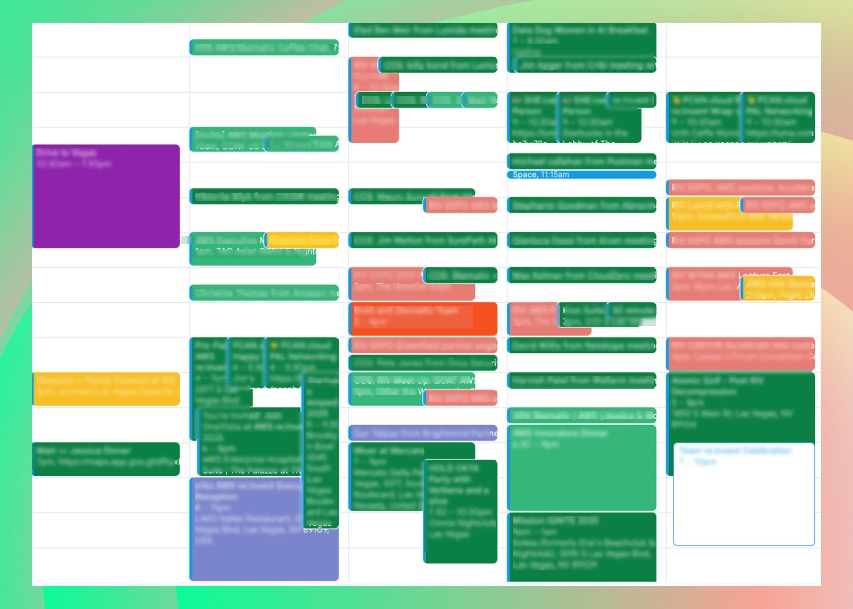
I started reaching out to AWS L10s in August. I color-code my calendar to track what percentage of time our team spends with prospects, partners, investors, and in educational sessions. At this point, we need strong development partners and prospect engagement in order to solidify our ideal customer profile and secure our first 10 customers. Next year, that mix might look completely different where we are actively co-selling with AWS and engaged in their new service launches as a design partner.
What I want every founder to know: re:Invent isn’t just for engineers. There’s enormous value for salespeople, partner teams, executives, and marketers. But it’s easy to get overwhelmed and spend the entire event bumping into people you know. You have to be intentional about your ICP and make every meeting count.
In addition to AWS partner sessions, be sure to check out the competition and their presence and messaging. How are my competitors showing up? Is their booth busy? What’s their messaging? What service integrations do they have? Skematic’s competitive analysis helps you get in the best position against your competition. We also suggest reaching out to your top prospects for end of year deals and see if they’re attending re:Invent. Skematic’s re:Invent readiness ensures you are well positioned to take full advantage of the conference.
The modern advantage
What’s genuinely different about going to re:Invent as a startup in 2025 versus when I started in 2017 is the go-to-market tools available to us now.
At CrowdStrike, I self-generated every single meeting. I personally reached out to people and manually scheduled everything, and I’m sure I missed hundreds of opportunities simply because I couldn't scale myself.
This year at Skematic, working with HLX, we’ve been able to take a completely different approach. We ran an outbound campaign across my LinkedIn network, reaching out to hundreds of curated contacts. My scheduling link is now full of meetings I didn’t personally initiate. I never could have done that level of outreach manually. Additionally, Skematic is partnering with cloud partnership thought leaders like Partnership Leaders, Tackle.io, and Partner Cloud Advisory Network (PCAN) to extend our reach and messaging.
This is the advantage modern startups have: you can reach your entire network at scale, with personalization, and show up to re:Invent with a full calendar of the right meetings, not just the ones you had bandwidth to manually schedule.
My advice to founders
At re:Invent this year, Skematic is sponsoring a pre-party with Partnership Leaders that has over 700 people registered. We’re using the same modern GTM tools and strategies we’re building for our customers, all with the benefit of knowing what worked (and what really didn’t) over eight years.
If you’re a startup founder wondering whether re:Invent is worth it, it absolutely is. Not necessarily for the booth (you might not need one yet), but for the education, the relationships, and the blueprint it provides for what’s possible when you truly integrate with the AWS ecosystem.
The journey from that tiny kiosk to a multi-billion-dollar partnership took intentional relationship-building, executive buy-in, and showing up year after year, ready to learn. You don’t need to have it all figured out on day one. You just need to show up.
.svg)

.svg)